from 0 review
1 h 30 min
Daily Tour
20 people
English, Italian
Led by a professional private guide, you will walk through Rome’s historic centre after dark, when illuminated monuments and quiet streets create the ideal atmosphere for exploring the city’s more mysterious side. Along the route, learn how plants, animals, geometric forms, obelisks, fountains and allegorical figures have been used to communicate political, spiritual and philosophical messages.
Rather than presenting every symbol as proof of a secret code, your guide will distinguish documented history from legends, popular interpretations and later Masonic associations. The result is an engaging journey through Rome’s artistic language and the ideas that have shaped the city from antiquity to modern Italy.
This exclusive two-hour private walking tour is ideal for curious travellers, history enthusiasts and returning visitors looking for an unusual Rome experience away from the standard sightseeing routes.
Your journey into hidden Rome begins near Piazza Venezia at the imposing Vittoriano, also known as the Monument to Victor Emmanuel II and the Altar of the Fatherland.
Designed by architect Giuseppe Sacconi after the unification of Italy, the monumental complex celebrates Victor Emmanuel II, the first king of a unified Italian nation. Its vast stairways, statues, columns and allegorical decorations were conceived as a visual expression of national identity, civic virtue and political unity.
Your guide will help you interpret the symbolic language found throughout the monument. Palm branches evoke victory, laurel represents honour and peace, while oak traditionally expresses strength, endurance and authority. Female allegorical figures, animals and classical motifs connect the monument with the artistic traditions of ancient Rome.
The Vittoriano is sometimes discussed in relation to the political culture of post-unification Italy, an era in which several important public figures were associated with Freemasonry. During the tour, you will examine these historical connections carefully while learning how classical imagery was transformed into a modern language of national unity.
Illuminated against the evening sky, the Vittoriano offers a dramatic introduction to the political and symbolic heart of Rome.
Continue through the streets of central Rome to Piazza del Gesù, named after the Church of the Gesù, the mother church of the Society of Jesus.
Beyond its importance in Catholic history, the square is also associated with an important chapter in Italian Freemasonry. The Gran Loggia d’Italia, an Italian Masonic obedience rooted in the Ancient and Accepted Scottish Rite, emerged from a division within Italian Freemasonry in 1908 and became historically identified with Piazza del Gesù.
This remarkable location therefore brings together different and sometimes conflicting intellectual traditions: Catholic authority, political power, freedom of conscience and Masonic thought.
As you admire the surrounding architecture, your guide will explain how the square became linked to the expression “Freemasonry of Piazza del Gesù” and how different Masonic obediences developed in modern Italy.
The tour continues to Palazzo Giustiniani, an elegant historic palace near the Pantheon with a complex story that connects aristocratic Rome, extraordinary art collections, Italian politics and Freemasonry.
The original nucleus of the palace was constructed during the late 16th century and purchased by the powerful Giustiniani family in 1590. Over time, the residence expanded into an extensive urban complex. Its celebrated collection included ancient sculptures and major works of art, making the palace an important destination for European aristocrats and cultured travellers undertaking the Grand Tour.
In 1901, Palazzo Giustiniani became the headquarters of the Grande Oriente d’Italia. The building consequently acquired the informal name “Green Vatican,” reflecting its prominence within Italian Freemasonry and its symbolic contrast with the nearby Catholic centre of power.
During the Fascist period, Freemasonry was suppressed and the palace became the subject of a long and complicated dispute. Today, Palazzo Giustiniani forms part of the Italian Senate complex and remains an important site in the history of the Italian Republic.
From the exterior, your guide will introduce the palace’s architectural details and explain its transformation from aristocratic residence to Masonic headquarters and institutional building.
Your exploration of esoteric Rome continues to Campo de’ Fiori, one of the city’s most atmospheric squares. At its centre stands the dark, hooded monument to Giordano Bruno, one of Rome’s most powerful symbols of intellectual freedom.
Bruno was a Dominican friar, philosopher and cosmological thinker whose ideas brought him into conflict with the Roman Inquisition. After a long trial, he was executed in Campo de’ Fiori on 17 February 1600.
The monument was created by sculptor Ettore Ferrari and inaugurated in 1889. Ferrari later served as Grand Master of the Grande Oriente d’Italia, and the monument became closely associated with secular thought, freedom of conscience and opposition to religious intolerance.
Look closely at the statue and its pedestal. Bruno faces toward the Vatican, holding a book beneath his folded hands. The base features portraits of other thinkers who challenged religious and intellectual authority. These details transform the monument into more than a memorial: it becomes a public statement about knowledge, independent thought and the right to question accepted beliefs.
Under the evening sky, the hooded figure creates one of the most evocative and memorable scenes on this private Masonic tour of Rome.
Approaching the Pantheon, discover how one of ancient Rome’s most extraordinary buildings communicates through proportion, geometry and light.
From the exterior, your guide will introduce the mathematical harmony of its monumental portico and explain how the building has inspired architects, philosophers and artists for almost two thousand years. Its circular design and celestial associations have encouraged many symbolic interpretations concerning cosmic order, perfection and the relationship between earthly and divine space.
The Pantheon is not presented as a Masonic temple. Instead, it is explored as an architectural masterpiece whose geometry and symbolism later resonated with philosophical and initiatory traditions.
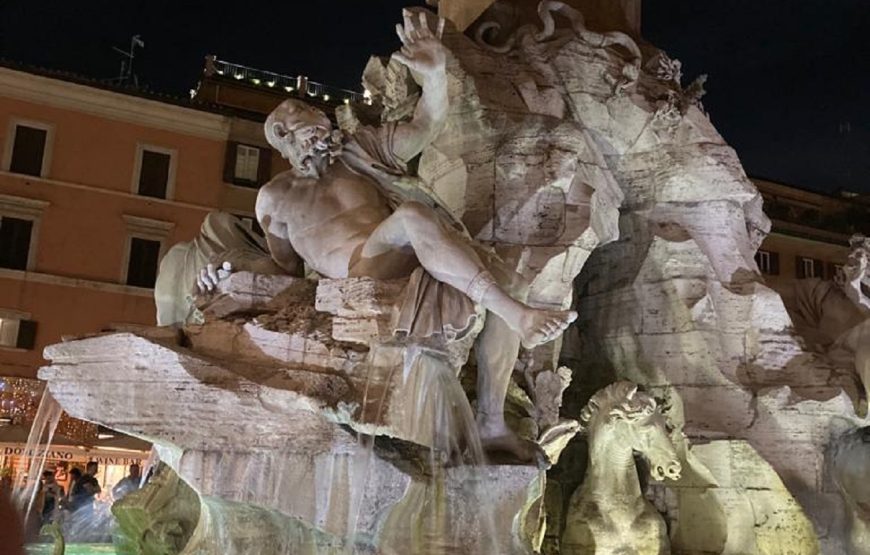
The tour concludes in Piazza Navona, where architecture, water, sculpture and an ancient-style obelisk come together in one of Rome’s most theatrical urban settings.
At the centre of the Piazza Navona stands Bernini’s Fountain of the Four Rivers, completed in 1651 for Pope Innocent X. Four monumental river figures represent the Danube for Europe, the Ganges for Asia, the Nile for Africa and the Río de la Plata for the Americas.
Water, one of the most powerful and universal symbols of life, purification and transformation, moves through the rocky structure beneath the obelisk. Animals, plants and allegorical figures turn the fountain into a symbolic representation of the known world.
The obelisk rises above the composition as a powerful vertical axis. At its summit is a bronze dove carrying an olive branch—the emblem of the Pamphilj family and a symbol connected with peace and the Holy Spirit.
Your guide will explain Bernini’s documented Christian and papal symbolism before exploring the broader esoteric interpretations that have become associated with the four elements, the four cardinal directions and the symbolic journey from earthly matter toward light.
This is not a conventional sightseeing tour. It is a carefully guided exploration of Rome’s hidden visual language and the relationship between monuments, political history, philosophical movements and Masonic tradition.
Because the experience is private, the guide can adapt the commentary to your interests. You will have time to ask questions, examine architectural details and discuss the difference between verified history, symbolic interpretation and popular legend.